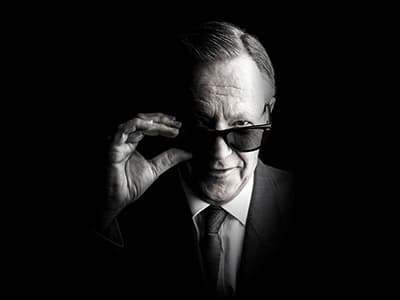
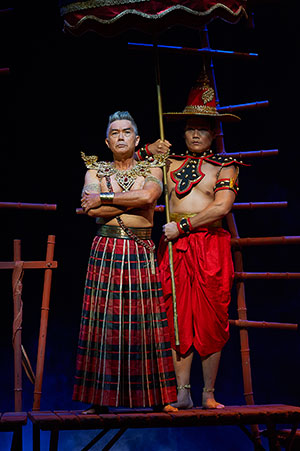
 Left – Will Centurion. Cover – Lisa McCune, Teddy Tahu Rhodes and Marty Rhone. Photos – Brian Geach
It may be difficult for some of my generation to entirely appreciate what a tremendous landmark musical The King and I was, with the subsequent eras of hit musicals replete with acrobatic arias, dropping chandeliers, landing helicopters, and flying witches that have come since. The spectacular element of this show when it debuted in 1951 was, and remains today, in large part due to the exotic nature of the opulent scenery and costumes, relying on the presumed unfamiliarity of the audience with the ritualised and ostentatious cultural display, recreating the Siamese court of over a century ago. This revival of the Tony Award-winning 1991 Australian production is a feast for the eyes indeed, with its large cast and procession of lush scenery, eye-popping costumes and fine stagecraft, even if nothing levitates, explodes or sails across the stage. With a talented cast including many adorable child performers, it is a show by which it is very hard not be won over.
As a narrative, however, it may also strike some as a little thin, based such as it is on a fictionalised version of Anna Leonowens’ memoir. With its plot comprising an occasionally awkward assembly of incidents which build with erratic causality towards a rather unexpected climax and an even less conventional denouement, it is a show which is supported not by the structure of its story so much as the engrossing combination of spectacle and, above all, the crucial interaction between its memorable central characters.
Because indeed we all know the main reason this production exists, ultimately, and that is to see the re-pairing of co-stars Lisa McCune and Teddy Tahu Rhodes. Their reunion makes this production a follow-up of sorts to their tremendously successful touring run of South Pacific from 2012. McCune and Rhodes’ onstage chemistry is undeniable, a point I made when reviewing that previous show before all the tabloid tumescence over their salacious breaking “news”. However, unlike the fairly passionate embraces and duets of South Pacific, this very different 19th Century subject matter dictates a far more chaste, subtextual relationship between its stars, their new roles showcasing an attraction which is barely acknowledged, let alone consummated.
In its place we have a much subtler, more precarious affection, a meeting of the minds and a battle of not only the wills, but also sexes, and even the civilisations of our two protagonists, who are so often at loggerheads. Indeed, East-meets-West is a central theme of the story, as are questions of what constitutes civilised behaviour and wise rule, the myopia of insular patriotism and the distinction between differing definitions of slavery when living under the fickle rule of an absolute monarch. The King of Siam wrestles between a desire to embrace the challenges to his world-view brought by “scientific” Western education, versus the inertia of tradition, which dictates he maintain his aura as an authoritative, omniscient autocrat.
Indeed, much of the charm, comedy, and ultimately the drama of the piece derives from the genteel yet headstrong widowed teacher Anna having to adjust to placating the King’s ego and capriciousness without completely backing down, whilst in turn coming to appreciate his noble qualities. It is in many respects the story of their gradual compromise, with her refusing to be relegated to the role of a royal subject yet learning to play the game of allowing the monarch to maintain his pretense of infallibility. In turn, the King comes to privately accept how much he needs Anna’s sage counsel, and even realises that he truly cares for this “very difficult woman”.
While the musical (let alone this production) is hardly going to be lauded for promoting especially progressive attitudes on issues of gender and race, it does take a more than sidelong view at historical questions of freedom and imperialism, not least of which in discussion of the contemporaneous American Civil War, and the extensive scene in which The King’s many wives enact a Siamese rendition of Uncle Tom’s Cabin for visiting English dignitaries. While the musical does not delve deeply into the history of Siam, it is helpful to be armed with the metaknowledge that the now modern-day Thailand is the only Southeast Asian nation to have entirely avoided colonisation. This does have bearing on a subplot concerning a British plan to make it a protectorate, and the King’s desire for Anna to help him disprove any notion of himself as a mere “barbarian” ruler.
These issues, and the ways in which Rodgers and Hammerstein dealt with them are by necessity a product of their time, as a 1950s musical which was in turn a 1860s period piece. Audiences’ willingness to accept aspects of the portrayal and particularly its casting have been and will no doubt continue to be varied and deserving of discussion. For those who wish to unpick, decode and contest the propriety of casting (one might even suspect conceiving) a production around the magnificent bald head of Teddy Tahu Rohdes as the King of Siam, evoking that of the role’s iconic originator and most prolific performer in the likewise Caucasian Yul Brynner, there is certainly fuel for debate.
What there can be no doubt of, however, is Rhodes’ magnificent performance of the role. While his portrayal of the King feels reminiscent of Brynner’s to an extent that may strike you as either respectful homage or potential mimicry, and the musical does not afford him as impressive or as many songs with which to display his stunning voice as did South Pacific, let alone his opera career, Rhodes remains nonetheless exceptional. Equally adept at the stern imperiousness and considerable humour the role requires, Rhodes is funny and captivating in equal measure.
Also excellent is Lisa McCune, who gives “Mrs. Anna” every bit of the warmth, stubbornness and long-suffering grace called upon for this proud, independent fish-out-of-water teacher who changes the course of the Siamese monarchy. The role is endearing and has a wonderful interplay with the King, and McCune and Rhodes make a fine double-act once again, and unsurprisingly it is their scenes of banter and argument which are far and away the highlights of the show.
In some respects though this is a comparatively bland role for McCune, reminiscent of her turn many years ago as Maria in The Sound of Music and some uninspiring television work, at least compared to several of her more, dramatically meaty, fun and vocally exciting roles in other musicals such as Cabaret, Guys and Dolls, and of course South Pacific. While she more than holds her own, this time around one did feel her somewhat eclipsed and overshadowed by Rhodes as the more engaging character of the King.
The “Shall We Dance?” scene is a barnstorming high note for this production, the sheer exuberance of the two characters reeling around the stage as they come together in harmony for the first time, with the usually complex set largely cleared for the ebullient swoop of McCune’s voluminous skirts and the stomp of Rhodes’ bare feet duly given all the focus. Almost perfectly mirroring its execution in the iconic 1956 film adaptation starring Deborah Kerr as Anna and perennial King of Siam Yul Brynner, this delirious dance sequence serves in many respects as the climax of the play, despite the few dramatic scenes yet to follow. This moment is what people think of when they conjure The King and I, and this theatrical couple bring it to life masterfully.
Quibbles over certain aspects aside, this is a very fine show predicated on a superb double-act, ably supported by a large cast and a lavish production design. Together they anchor a spectacular rendition of a classic musical, filled with pageantry and pathos, wit, humour, and heart. Recommended for all lovers of classic Broadway.
Opera Australia and John Frost present
The King and I
by Rodgers and Hammerstein
Venue: Sydney Opera House
Dates: September 7 – November 1, 2014
Bookings: thekingandimusical.com.au